Translate

Sunday, March 23, 2014

Hens on International Women's Day

Feminist Hens were shown on International Women's Day on 8th March in the Office of the European Parliament. The Hens were accompanied by a debate "Preventing Violence against Women".


Friday, March 14, 2014

Euroasia

Euroasia is the next painting after “Eauroarabia” and concerns migration matters. 
 "Euroarabia" is a picture reffering to the subject of migration, cultural penetration and mingling of cultures as well as the disappearance of borders between countries.
The current Globalization Era has it's possitive aspects, such as broadly understood mobility and the possibility of communication, but also negative ones, that were metioned by Oriana Fallaci and others, such as the unrest related to the migrations of the Musilm milieus and their influence upon the European countries and the USA. The picture also touches upon the problems of Musilm women who still do not have full freedom and liberties. 
In Euroasia I show mixed European and Chinese culture. You noticed Chinese dragons, lanterns and a lot of funny, colorful, mass-products we can find and buy everywhere, almost everywhere on earth.


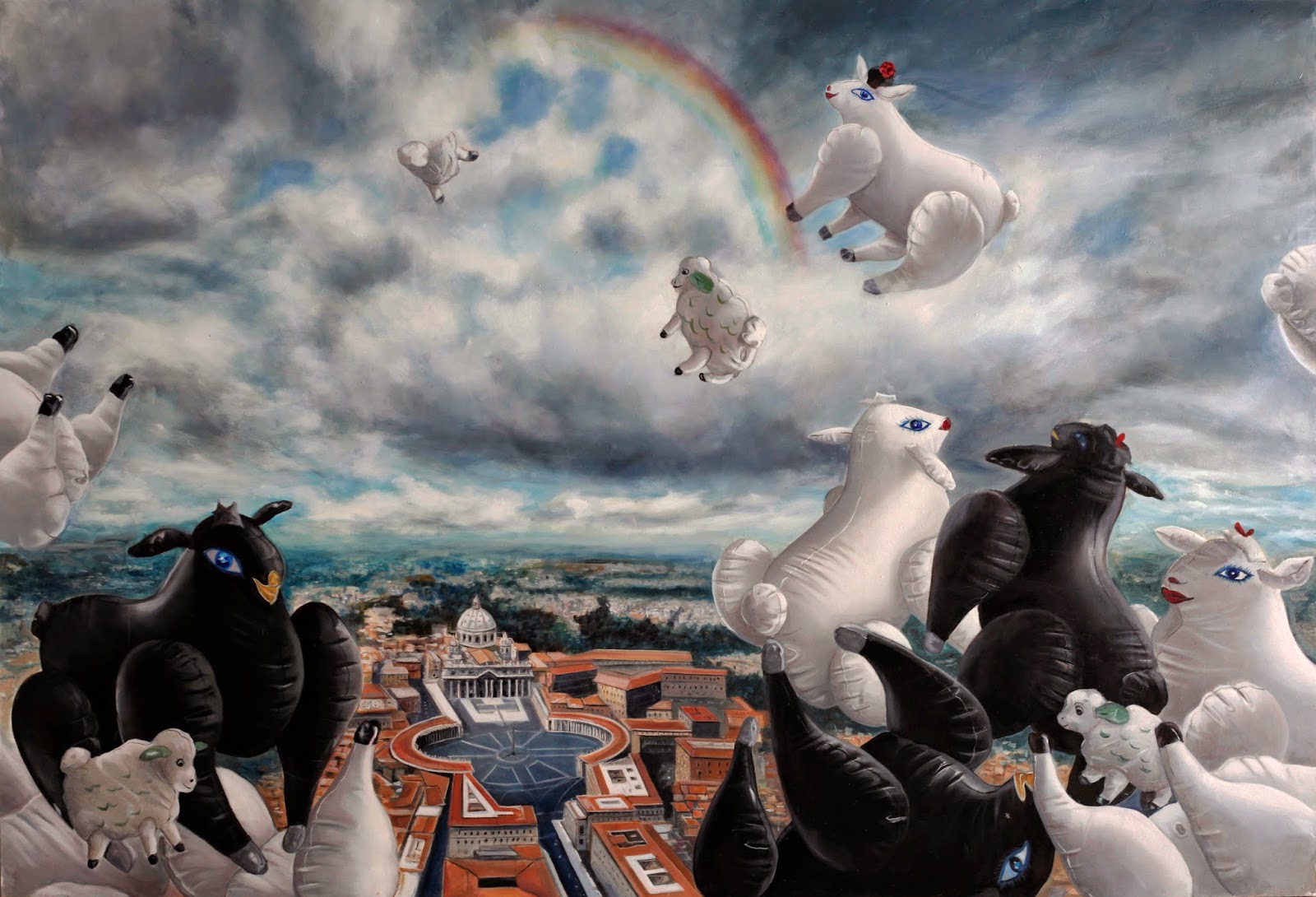
"Lambs of God katharsis"

The "Lambs of God katharsis"is another work reffering to the motif of blown lamb ballons, known elsewhere from a recognizable work "Lambs of God", which pictured a heard of white and black  lambs floating over Warsaw and its central point-Palace of Culture. The painted lambs were patterened on erotic toys. The work touched upon the boundary between the sacred and the profane, as well as hypocrisy related to religious superficiality. It also referred to social issues by telling that we represent  a sheepfold composed of "sinful lambs of God".
 The recent work shows a heard of white and black lambs floating over the Vatican , precisly over St. Peter's Square.It refers to the latest, widely commented "sexual"scandals in the Catholic Church. After the problems were publicized , actions were taken to clear the representatives of the clergy of the ofences in this matter, that is to remove from power the balck sheeps of the Church.
 We can see the rainbow in a picture, which is a symbolic sign of the allance between God and man as well as the symbol that LGTB have chosen for their "logo".


"Uprising 44"

“Uprising 44” refers to the older painting titled “Fairy Uprising 44”. We can see a dark, dusty and cold place on the painting, where we can feel the breath of death. It’s a landscape after a war, where thousands of young people, boys and girls sacrifice their lives for their mother country. You notice also symbolic Mother, a figurine of Saint Mary in a cloud of dust. Inside the bubbles we can see different, delicate things and the faces (real photographs) of young people who died during the Uprising. They are the symbolic spirits of those young people. The painting was ordered by The Warsaw Rising Museum.


Saturday, December 28, 2013

"Euroarabia" - new project of art in public space


„Euroarabia” 

„Słowa nie tylko przekazują idee i kryjące się za nimi rzeczy, ale także same się przeobrażają, przeistaczają w zetknięciu ze sobą (…) W ten właśnie sposób przenoszą i udostępniają nam idee” (Jean Baudrillard).

Instalacja „Euroarabia”  (Julia Curyło / Liza Sherzai) składa się z 40 pneumatycznych rzeźb o wielkości 130 cm x 220 cm każda wykonanych z miękkiego poliuretanu w formie matrioszek.

Przewidziana jest realizacja czterdziestu sztuk pneumatycznych „matrioszek” wchodzących w skład instalacji artystycznej pt. „Euroarabia”. Dmuchane „lalki” wykonane są ze specjalnej folii. Wybór materiału podkreśla zmienność, płynność, niestałość w kontekście zjawisk i pojęć na które nakłada się filtr percepcji. 30 rzeźb zostanie umocowana do podłoża, a 10 przywieszona do sufitu na przezroczystych żyłkach (instalacja w przestrzeni zamkniętej). Rzeźby umieszone na wiankach lub podwieszone do sufitu zostaną pokryte nadrukiem – wykaligrafowane barwne perskie i polskie napisy układające się w ażurową burkę. Odkryta część twarzy (oczy) przedstawią kobiety wybitne: artystki, pisarki, działaczki społeczne. Napisy w języku perskim i polskim ­ to „słowa klucze” odnoszące się do ważnych zjawisk społecznych. Matrioszki w sposób wizualny przybliżają „trudne” semantycznie pojęcia i tematy.  Etymologia „matrioszki” łączy się z łacińskim wyrazem „mater”, czyli matka. Utożsamiająca przeważnie kobietę matrioszka jest symbolem społecznej mentalności. Stereotypowym wizerunkiem lalek jest postać młodej dziewczyny z rumianymi policzkami, wielkimi oczami i gęstymi włosami. Całość zdobią wielobarwne malunki pięknych sukien i kwiecistych chustek. W instalacji „Euroarabia”  matrioszki noszą burki i mają prawie całkowicie zasłonięte twarze. Dominujący kolor to czarny. Kolorowe są napisy, odsłonięta część twarzy oraz kwietne podstawy. Instalacja podejmuje tematykę równości kobiet i mężczyzn we współczesnym świecie, odnosi się do aktualnych zjawisk społecznych i politycznych, stawia znak zapytania w stosunku do pojęcia „tożsamość” w dobie migracji, porusza kwestie stereotypów, podejmuje debatę ze zjawiskiem feminizmu. Odnosi się do tematu wspierania kobiecej kreatywności, przedsiębiorczości i działalności artystycznej oraz dyskryminacji materialnej pracy kobiet środowiskach artystycznych. Poprzez „słowa klucze” zadaje pytania i skłania do refleksji.  W nazwie „Euroarabia” - „Euro” i „Arabia” są metonimiami o szczególnych znaczeniu. Aby opisać problematykę zagadnienia artystki posługują się ironią, groteską, dyskomfortem i absurdem.